
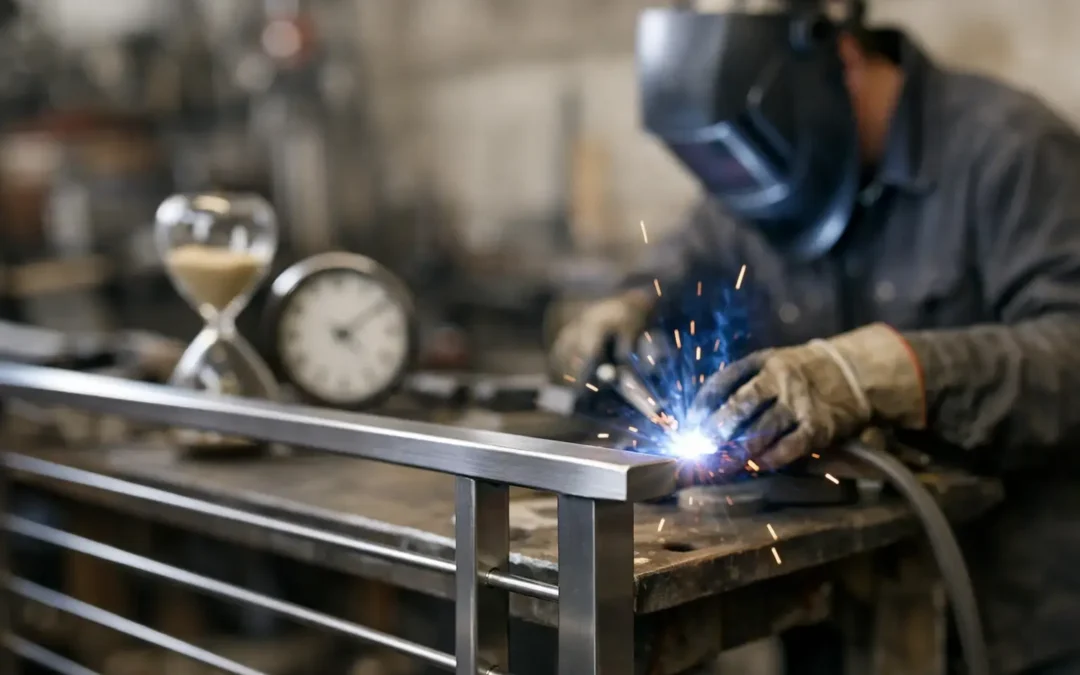
If you are planning a new railing for a stair, balcony, porch, or commercial space, one of the first questions is simple: how long does railing fabrication take? The honest answer is that custom work moves on a real production schedule, not an off-the-shelf one. A straightforward project may move quickly, while a fully custom, engineered railing system with glass, specialty finishes, or permit requirements will naturally take longer.
That is not a bad thing. With premium railings, the timeline reflects the work behind a clean final result – accurate measurements, design coordination, code alignment, fabrication, finishing, and installation. When the process is handled properly, you get a railing that looks right, fits right, and performs the way it should for years.
How long does railing fabrication take for most projects?
For most custom residential railing projects, fabrication typically takes anywhere from 2 to 6 weeks after measurements, drawings, and approvals are complete. For more complex commercial jobs, multi-level stair systems, or projects requiring engineering review and stamped drawings, the full fabrication window can extend beyond that.
The key detail many property owners miss is this: fabrication does not start the day you first ask for a quote. It usually starts after the site visit, final measurements, design confirmation, material selection, and approval of project drawings. If engineering is required, that step also needs to be completed before production moves forward.
In practical terms, the overall project timeline often looks more like this: consultation and site measure, drawings and approval, engineering if needed, fabrication, then installation. So when clients ask how long the whole job will take, the answer is usually longer than the shop production time alone.
What affects how long railing fabrication takes?
No two railing jobs move at exactly the same pace because no two spaces are exactly the same. A clean interior handrail for a finished staircase is different from a frameless glass balcony system exposed to weather, drainage concerns, and stricter structural demands.
Design complexity
Simple designs usually move faster. If the railing uses standard profiles, straightforward dimensions, and a clear layout, production is more efficient. Curved sections, custom scrollwork, mixed materials, unusual angles, and one-off architectural details add time because they require more shop labor and more review before cutting and assembly begin.
This is especially true with custom blacksmith-style work or railings meant to become a visual centerpiece. Fine craftsmanship takes time, and that time is visible in the finished result.
Material selection
Different materials move through production differently. Aluminum systems are often faster to fabricate than more intricate wrought iron pieces. Stainless steel may require a different finishing process. Glass railings depend not only on metal fabrication but also on glass production, tempering, and coordination of exact panel sizes.
If your project includes custom glass, lead times may be tied to both the fabrication shop and the glass supplier. That can affect the schedule even when the metal components are ready.
Site conditions and measurements
A railing is only as good as its fit. If field conditions are uneven, incomplete, or still changing because another trade is finishing tile, concrete, framing, or flooring, fabrication may need to wait until final dimensions are confirmed.
This is one of the biggest reasons timelines shift. Measuring too early creates risk. Measuring at the right stage protects the fit, the finish, and the installation date.
Drawings, approvals, and revisions
Clients often focus on production time, but approvals can add just as much time as shop work. If drawings are approved quickly and there are no major revisions, the project moves forward smoothly. If design changes continue after drawings are issued, the schedule naturally stretches.
That is why a structured workflow matters. Clear drawings and timely approvals keep a custom project moving without surprises.
Engineering and permit requirements
For some railings, especially exterior systems, elevated balconies, commercial properties, or projects with specific municipal requirements, engineering review and stamped drawings may be necessary. This step adds time, but it also adds protection. It helps ensure the railing is built to meet code and perform properly in the real conditions it will face.
For homeowners and contractors, this is often worth the extra time because it reduces risk later in the process.
A realistic timeline from quote to installation
Most clients do not actually want to know only how long railing fabrication takes. They want to know when the railing will be installed. That broader timeline is what helps with renovation planning, occupancy dates, and contractor coordination.
A typical custom railing project often begins with a quote request and site visit. Once measurements are taken, drawings are prepared based on the job conditions and the selected design. The client reviews and approves those drawings. If engineering review is required, that happens next. After approvals are complete, fabrication begins. Finishing, powder coating, or glass coordination may follow, and then installation is scheduled.
If everything is straightforward and decisions are made promptly, a smaller residential project may move from first measure to installation in a few weeks. If the project is larger, highly customized, or tied to a broader construction schedule, it may take notably longer.
The important point is that a good fabricator does not rush past the stages that protect quality. A railing is not decorative trim alone. It is a safety feature, a visible architectural element, and a permanent part of the space.
Why custom railings take longer than stock systems
If you have seen ready-made railing kits online, custom fabrication can seem slower at first glance. But those are not equivalent products.
A stock system is designed to fit a general condition. A custom fabricated railing is designed to fit your actual site, your exact dimensions, your style goals, and the structural demands of the project. That means more coordination up front, but it also means fewer compromises at the end.
Custom fabrication is often the better choice when you want a clean modern look, unusual dimensions, higher-end finishes, glass integration, or confidence that the installation will feel intentional rather than pieced together.
How to keep your railing project on schedule
While some factors are outside anyone’s control, there are a few ways to avoid unnecessary delays. The first is making design decisions early. If material, finish, and style choices keep changing, drawings and production cannot move forward efficiently.
The second is making sure the site is ready for final measurement. If flooring heights, stair finishes, or concrete edges are still in flux, waiting for the correct moment to measure is smarter than remaking components later.
The third is working with a company that handles the process in a disciplined way. A professional workflow with site measurement, job-specific drawings, approvals, engineering coordination, and organized installation scheduling creates a more dependable timeline than a casual order-and-build approach.
This is where experience matters. A team that fabricates and installs railings every day knows how to identify timeline risks before they become expensive problems.
When faster is not better
Many clients understandably want the shortest possible lead time. But with railings, speed alone should not be the deciding factor.
If fabrication begins without accurate measurements, the final fit can suffer. If engineering is skipped where it is needed, the project can face compliance issues. If finishing is rushed, the railing may not hold up the way it should. A dependable schedule is better than a fast promise that leads to rework.
The best results usually come from a balanced process – efficient, organized, and realistic. That gives you the confidence that the railing will arrive looking the way it did on paper and install the way it was intended.
The answer clients appreciate most
So, how long does railing fabrication take? In most cases, expect a few weeks for fabrication after approvals, with the full project timeline depending on design complexity, material selection, engineering needs, site readiness, and installation scheduling.
At Iron & Glass Designs, the goal is not simply to produce a railing quickly. It is to guide each project from measurement through installation with the kind of precision that makes the final result feel worth the wait. If you are planning a railing project, the most helpful next step is to get a clear quote and timeline based on your actual space, not a generic estimate. That is how good design gets materialized properly.