
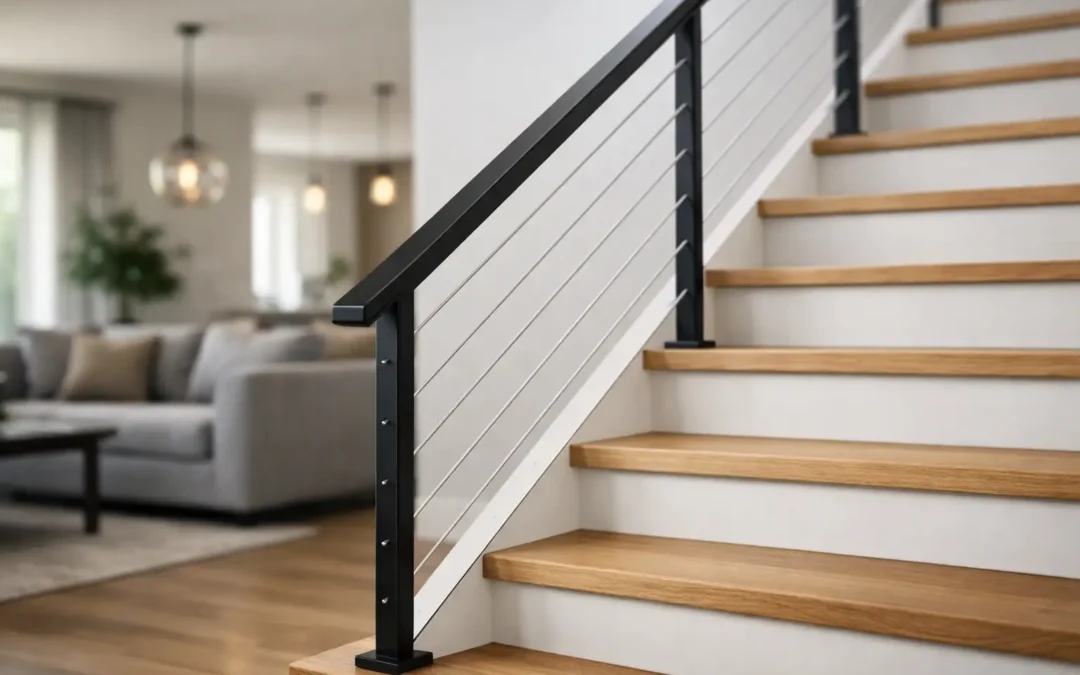
The old stair railing did its job, technically. It kept the stair open side guarded, but visually it cut the entry in half, made the hallway feel darker, and dated the entire main floor. This case study stair railing modern renovation shows what changed when the goal was not just to replace a railing, but to rethink how the stair should look, feel, and perform in a renovated home.
The project started with a common problem in modern remodels: the stairs stayed in the same location, but everything around them was getting cleaner, brighter, and more contemporary. New floors, updated lighting, and a renovated kitchen were already planned. The original railing, built with bulky wood posts and traditional spindles, suddenly looked heavier than ever. The homeowners wanted a more open look, stronger sightlines, and a finished result that felt custom rather than off-the-shelf.
What the homeowners wanted from the renovation
The brief was straightforward, but the details mattered. They wanted a modern stair railing that would visually open the main level without making the staircase feel exposed or unfinished. Safety was a priority because the home had children and frequent guests. At the same time, the railing had to suit the architecture of the house instead of looking like a trendy add-on.
This is where many renovations become harder than expected. A railing is not just a decorative feature. It needs to meet code, fit the exact stair geometry, align with adjacent walls and landings, and still look proportionate from every angle. What reads as minimal in a photo can become awkward on site if the dimensions, fastening points, and transitions are not resolved properly.
For this project, the design direction focused on slim metal framing with glass infill. That choice gave the homeowners the clean lines they wanted while preserving openness between the foyer and living space. It also made sense from a maintenance standpoint. Compared with more intricate traditional systems, the final concept would be easier to clean and less visually busy.
Case study stair railing modern renovation: the design decision
Several railing options were considered early on. A fully wrought iron look would have added strength and character, but it was not the right match for the rest of the remodel. Horizontal pickets offered a contemporary appearance, yet they would still create visible visual barriers across the stairwell. Frameless glass was attractive, but in this specific home it required a closer review of mounting conditions and edge protection details.
The final direction balanced aesthetics, structure, and budget: a custom powder-coated metal railing system paired with clear glass panels. This gave the project what many homeowners are really after in a renovation – a premium look that feels light and architectural, without overcomplicating fabrication or installation.
A good modern railing should do more than disappear. It should sharpen the architecture around it. In this home, the black metal frame gave definition to the staircase, while the glass panels allowed natural light from the front entry and rear windows to travel farther into the space. The stair became a design feature instead of an obstacle.
Why measurement and drawings made the difference
One of the biggest reasons railing projects go wrong is that people underestimate how custom they are. Stairs are rarely perfectly uniform, especially in existing homes. Small variations in tread depth, riser height, wall straightness, and floor level can affect the finished result.
That is why the site visit stage matters so much. Precise field measurements were taken for the stair run, landing, and connection points at the upper floor. From there, job-specific drawings helped translate the homeowners’ ideas into something buildable. This part of the process is not flashy, but it is where quality starts.
Drawings also gave the homeowners a chance to review proportions before fabrication began. Post spacing, handrail height, glass panel sizing, and end conditions all had to be approved. On a modern design, these details stand out more because there is less ornament to hide mistakes. Clean lines only look effortless when the planning is disciplined.
In projects where permits or structural review are required, engineered review and stamped drawings can be another major advantage. They add confidence for homeowners, contractors, and inspectors because the railing is being treated as a real building component, not an afterthought.
Material choices and the trade-offs behind them
The finished system used durable metal framing and tempered glass, chosen for both performance and appearance. That combination is popular for a reason, but it is not one-size-fits-all.
Glass creates openness and elevates the overall look, especially in homes with updated floors, large windows, and minimalist finishes. It can also make smaller foyers and stair halls feel more spacious. The trade-off is that glass shows fingerprints and needs regular cleaning to stay crisp.
Metal framing adds definition, strength, and design control. A powder-coated finish can tie into door hardware, window frames, or lighting fixtures, which helps the railing feel integrated into the renovation. The trade-off is that the finish and fabrication quality need to be handled professionally. Poor welds, inconsistent coating, or imprecise joints are much easier to notice on modern work.
This is why craftsmanship matters as much as material selection. Premium materials do not automatically create a premium result. The detailing, fit, and final installation determine whether the railing feels custom or simply expensive.
The installation phase and what homeowners notice most
By the time installation started, most of the heavy decision-making was already complete. That is exactly how a well-managed project should feel. Production followed approved drawings, and the installation team arrived with components fabricated to suit the site conditions.
What homeowners notice most during this phase is not just the speed of the work. It is the precision. Posts line up correctly. Glass sits evenly. Transitions at landings feel intentional. The handrail meets the wall cleanly. Those details are what create the sense that the renovation was done professionally.
This project also highlighted something many people do not think about until late in the process: sequence. Stair railings are often installed alongside flooring, trim, and painting schedules. Good coordination prevents damage, delays, and costly rework. A railing company that understands the full workflow can save a homeowner a lot of stress, especially when multiple trades are involved.
The result of this modern stair railing renovation
Once installed, the difference was immediate. The staircase no longer interrupted the room. It framed it. Sightlines from the front entry through the main floor opened up, and the natural light that had previously stopped at the old spindle system carried much farther into the home.
The visual effect was significant, but the practical gains mattered too. The new railing delivered code-conscious safety, a more durable finish, and a cleaner surface profile that was easier to maintain. Just as important, it matched the level of the surrounding renovation. Nothing looked pieced together.
That is often the real benchmark for success in a project like this. A stair railing should not look like it was swapped in at the last minute. It should feel like part of the home’s architecture, designed for that exact space and built to last.
What this case study stair railing modern renovation teaches
The lesson from this project is simple: the best railing renovations are not driven by style alone. They succeed because design, measurement, engineering, fabrication, and installation are handled as one connected process.
Homeowners often start by saving inspiration photos, and that is a good first step. But photos do not account for your stair angle, landing layout, fastening conditions, or local code requirements. A strong result comes from working closely with professionals who can take an idea and turn it into an engineered, buildable solution.
For property owners planning a similar upgrade, the smartest approach is to decide early what matters most. If your priority is openness, glass may be the right choice. If low maintenance matters more, another infill option may make better sense. If budget is tight, there may be ways to simplify the design without losing the modern look. It depends on the home, the stair configuration, and how the railing needs to perform day to day.
At Iron & Glass Designs, this is exactly where a structured process proves its value. When measurement, drawings, approvals, engineering review, fabrication, and installation are aligned from the start, the result is more predictable and far more refined.
A stair railing renovation can seem like a small part of a larger remodel, but it has an outsized effect on how the home feels every single day. Get that element right, and the whole renovation looks more intentional.