
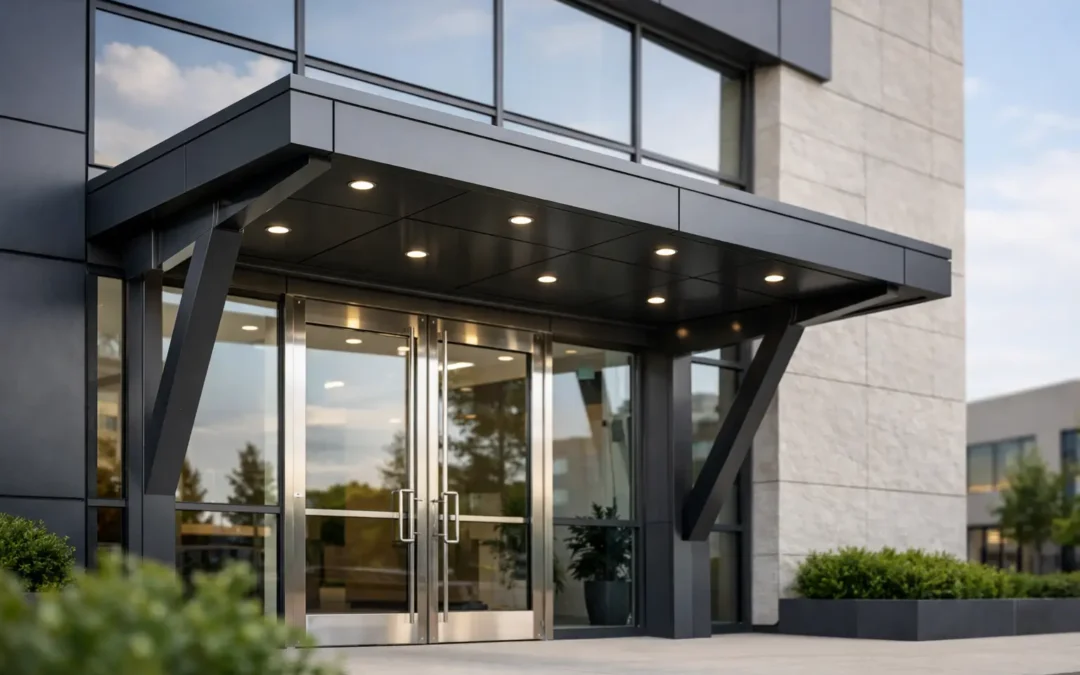
A front entry does more work than most property owners realize. It has to protect visitors from rain and snow, support the look of the building, and hold up under constant daily use. A commercial entrance metal canopy does all three when it is designed properly – and when it is built for the actual conditions of the site rather than treated like a generic add-on.
For retail spaces, office buildings, multifamily properties, and mixed-use developments, the canopy over the entrance often becomes the first physical interaction people have with the property. If it feels flimsy, undersized, or visually disconnected from the facade, that impression lands immediately. If it feels clean, durable, and intentional, the building starts communicating quality before anyone even steps inside.
Why a commercial entrance metal canopy matters
The practical case is straightforward. A canopy helps keep rain, snow, and dripping runoff away from the doorway, which can reduce slippery surfaces and make the entry more comfortable for customers, tenants, and staff. It also offers some protection for doors, frames, and glazing, which can help reduce wear over time.
The design case matters just as much. A commercial entrance metal canopy can sharpen the lines of an exterior, create a stronger sense of arrival, and make an entrance easier to identify from a distance. That is especially valuable on buildings with flat facades or minimal architectural detail. In many projects, the canopy is not just a weather cover. It is the feature that gives the entrance presence.
There is also a branding element. Even when there is no signage integrated into the structure, the canopy can reinforce the tone of the property. A slim black steel frame with glass infill gives a very different message than a heavier aluminum build with solid metal panels. Neither is automatically better. The right choice depends on the building, the tenant profile, maintenance expectations, and the image the owner wants to project.
What makes a good commercial entrance metal canopy
A good canopy starts with proportion. It should feel scaled to the width and height of the entrance, not oversized to the point that it overwhelms the facade and not so small that it looks like an afterthought. Projection matters too. A shallow canopy may look elegant in drawings but fail to provide meaningful protection once wind-driven rain or snow enters the equation.
Material selection is the next major decision. Steel offers strength and a more architectural feel, especially for custom detailing and slimmer profiles. Aluminum is lighter and can be a smart choice where corrosion resistance and lower maintenance are priorities. Stainless steel can be ideal for certain premium applications, though budget and visual fit need to be considered carefully. The best material is the one that fits both the design intent and the real-world demands of the site.
The connection details are just as important as the visible finish. A canopy is only as reliable as its structural supports, attachment points, and water management. That is where many off-the-shelf solutions fall short. They may look acceptable in a product photo, but once installed on a specific building with unique wall conditions, drainage patterns, and load requirements, the compromises become obvious.
Design choices that affect appearance and performance
Glass and metal is one of the most requested combinations for modern commercial exteriors because it delivers protection without making the entrance feel heavy. A glass-top canopy can help preserve natural light at the doorway and maintain a clean, open look. That said, glass is not the right answer for every property. It requires the right structural support, thoughtful detailing, and a realistic plan for cleaning and upkeep.
Solid metal canopies create a bolder presence and may simplify certain maintenance concerns, but they can also cast more shadow and feel visually heavier. Perforated or slatted elements can offer a middle ground, depending on the desired style. This is one of those areas where aesthetics and function need to be weighed together rather than separately.
Finish selection also has a larger impact than many clients expect. Powder-coated black, charcoal, bronze, and custom neutral tones remain popular because they work well with glass, masonry, stucco, and contemporary cladding systems. But finish is not only about color. It is also about durability, consistency, and how well the final product holds its appearance over time in a high-traffic exterior setting.
The code and engineering side of a commercial entrance metal canopy
This is where custom fabrication earns its value. A commercial entrance metal canopy is not simply a decorative feature mounted above a door. It is an exterior architectural element that may need to account for structural loads, connection requirements, local code considerations, and permit-related documentation.
Snow load, wind exposure, drainage, mounting substrate, and pedestrian clearance all matter. So does the specific use of the building. A canopy at a private office entrance may have different practical demands than one at a busy mixed-use property with constant foot traffic and delivery activity.
That is why the process matters as much as the product. The strongest outcomes usually come from a structured workflow: site measurement, project-specific drawings, client approval, engineering review where required, fabrication, and installation. That approach reduces guesswork. It also helps clients feel confident that what looked good in concept will perform properly once built.
For owners and contractors, this is often the difference between a smooth project and a frustrating one. A canopy that is measured accurately, drawn correctly, reviewed properly, and installed with precision has a much better chance of meeting both visual and technical expectations the first time.
Custom vs. prefabricated canopy systems
Prefabricated canopy systems can work in some situations, especially when the goal is speed and the site conditions are simple. They can be useful for tight budgets or secondary entrances where customization is not a priority. But there is always a trade-off. Standardized dimensions, limited finish options, and generic attachment details can make the final result feel disconnected from the building.
Custom canopies make more sense when the entrance is a focal point, when the architecture has a distinct style, or when site conditions require a more tailored solution. They also allow better coordination with railings, stairs, gates, and other metal or glass elements on the property. That consistency can make a major visual difference.
For many commercial clients, the real benefit of custom work is control. You are not trying to force a standard product into a nonstandard condition. You are working from actual measurements, real design intent, and a fabrication plan that fits the building.
What property owners should ask before moving forward
Before approving a canopy design, it helps to ask a few practical questions. How far should it project to provide meaningful coverage at this entry? What material best suits the building and expected maintenance level? Will the design integrate with existing facade lines, lighting, signage, or glazing? How will water be managed? And what approvals or engineering review may be needed before fabrication begins?
These questions are not meant to complicate the project. They help prevent expensive revisions later. A clean-looking canopy is only a successful canopy if it also works in bad weather, fits the structure correctly, and supports the long-term value of the property.
This is where working closely with a fabrication and installation partner matters. A strong team does not just ask what style you like. They help translate the look you want into something buildable, durable, and appropriate for the site. That balance between design and execution is what turns a concept into a finished entrance that feels complete.
At Iron & Glass Designs, that process-led approach is a big part of what clients value. Clear measurements, job-specific drawings, approvals, engineering review, and professional installation create a more dependable path from idea to finished result.
The best canopy is the one that fits the building
There is no single best commercial entrance canopy for every project. A downtown office, a retail plaza, and a multifamily residence may all need something different in scale, finish, structure, and visual impact. What matters is getting the proportions right, choosing materials that suit the property, and building with enough discipline that the finished work looks intentional from every angle.
A well-made entrance canopy does not need to shout. It simply makes the building feel better organized, better protected, and more professionally finished. If you are planning one, the smartest next step is to treat it as part of the architecture, not as an accessory added at the end.