
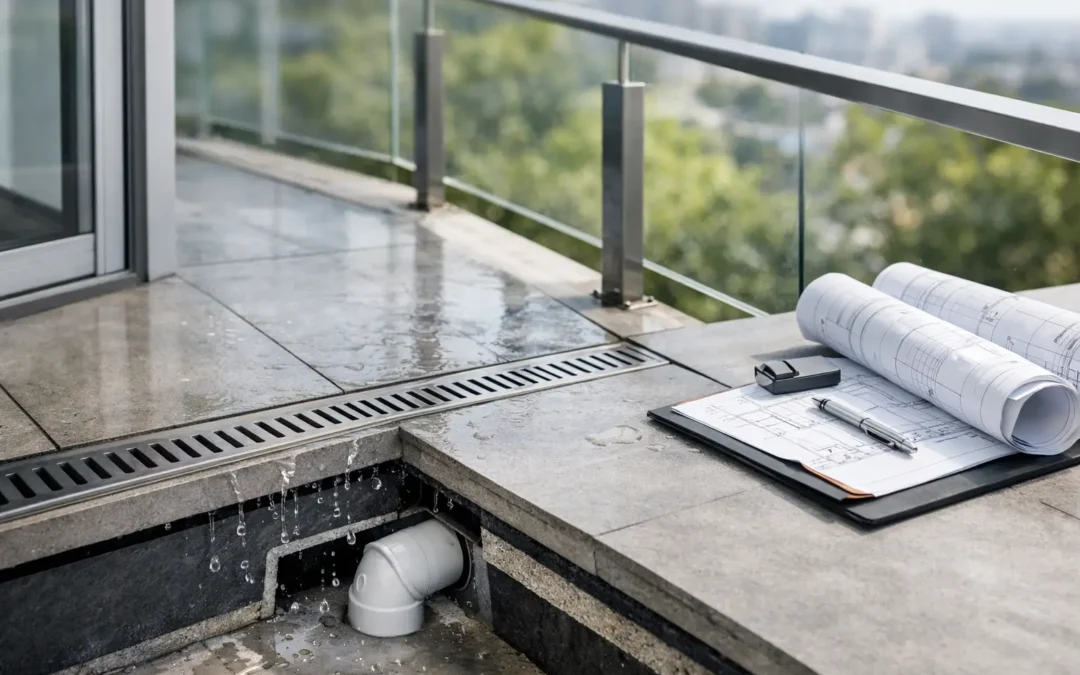
Water rarely announces a problem on day one. On a balcony, it usually starts with a shallow puddle near the door, staining at the slab edge, or moisture showing up below long after the installation looked complete. A strong balcony drainage design guide helps prevent those quiet failures before they become expensive repairs, damaged finishes, or callbacks.
For homeowners, builders, and property investors, drainage is not a side detail. It affects how long the balcony lasts, how safe it stays in wet or freezing conditions, and how well surrounding systems perform – from waterproofing to railing attachments. A balcony can look sharp on install day and still fail early if the water path was never properly planned.
What good balcony drainage design actually does
A well-drained balcony moves water away quickly, protects the structure underneath, and reduces the chance of staining, ice buildup, and membrane damage. That sounds simple, but the design has to coordinate several elements at once. The surface slope, drain placement, edge detailing, threshold height, and waterproofing all have to work together.
This is where many projects go off track. The finish tile may look level to the eye, the railing may be beautifully fabricated, and the waterproofing may be high quality, yet one weak transition can still trap water. Drainage is not one product. It is a system.
On custom balcony projects, especially where modern glass or metal railings are part of the design, that system needs to be resolved early. Drain locations, fascia profiles, and mounting details should complement the finished look, not fight it later.
Balcony drainage design guide: start with slope, not drains
The first rule in any balcony drainage design guide is that the surface should shed water by slope before it relies on drains. Drains are there to collect and direct water, but they should not be the only answer to a flat or poorly pitched balcony.
In most cases, a balcony surface needs positive slope away from the building or toward a planned drainage point. If the pitch is too shallow, water lingers. If it is inconsistent, low spots form. If the pitch sends water back toward doors or wall connections, the risk of leaks increases fast.
There is no universal detail that fits every balcony. A small projecting residential balcony may drain cleanly over an edge with the right slope and edge profile. A larger occupied terrace over living space may need internal drains, scuppers, or a more layered drainage assembly. The correct approach depends on size, exposure, structure, finish material, and what sits below.
That is why field measurement and project-specific drawings matter. Small dimensional differences can change how water behaves, especially around corners, door thresholds, and railing posts.
Why flat-looking balconies often become repair projects
Clients often prefer sleek, modern lines, and that usually means a clean visual plane. The challenge is that a balcony can appear flat while still being properly sloped, but only if the design is intentional. When installers try to preserve the look without respecting drainage geometry, the result is a surface that appears elegant and performs poorly.
Ponding water is not just a nuisance. Over time, it can discolor finishes, stress joints, accelerate freeze-thaw wear, and expose weaknesses in sealants and penetrations. On elevated balconies, it can also lead to hidden moisture migration into the supporting structure.
Choosing the right drainage method
The best drainage method depends on how the balcony is built and how it will be used. Open-edge drainage can work well where the slab edge allows water to run free and where below-grade splash or runoff will not create a problem. This is common on simpler balconies with straightforward geometry.
Internal drains are more common when the balcony sits over occupied space or when the perimeter detail does not allow water to discharge freely. These systems can be effective, but they require more precision. If a drain lands in the wrong spot or sits higher than the surrounding low point, water will remain on the surface.
Scuppers are another option, especially at parapet conditions. They can move water efficiently through a wall edge, but they need careful sizing and overflow planning. In heavy rain, a scupper that is too small or poorly placed can become the bottleneck.
None of these methods is automatically better. The right choice is the one that fits the structure, finish, and waterproofing strategy without compromising appearance or maintenance access.
Waterproofing and drainage must be designed together
One of the most common mistakes is treating waterproofing and drainage as separate scopes. They are tightly connected. The membrane has to direct water toward the intended discharge points, and every transition has to maintain continuity.
That matters even more around balcony doors, wall intersections, and perimeter edges. These are the areas where water tends to collect or reverse direction under wind-driven rain. If the membrane termination, flashing, or threshold detail is weak, water does not need a large opening to start causing damage.
This is also where premium fabrication and installation discipline make a visible difference. Clean metal detailing at edges and transitions is not just about appearance. It helps define the drainage path, protect vulnerable edges, and support long-term performance.
The problem with after-the-fact fixes
Many drainage failures are expensive because they are discovered after finishes, railings, and surrounding assemblies are already complete. At that point, even a simple correction may require demolition, re-waterproofing, and reinstallation.
A better process is to resolve drainage before fabrication is finalized. When site dimensions, slope strategy, mounting locations, and edge conditions are reviewed together, the project moves with fewer surprises. That is especially valuable on custom balcony builds where no two sites are identical.
Railings, posts, and penetrations need careful planning
For modern balconies, the railing system is often one of the most important visual elements. It can also be one of the biggest drainage and waterproofing risks if the attachment method is not coordinated.
Top-mounted posts, base shoes, fascia mounts, and embedded anchors all affect how the waterproofed surface is interrupted. Every penetration creates a point that must be detailed correctly. Poorly sealed fasteners or poorly located anchors can turn a high-end balcony into a leak source.
This does not mean drainage and design are in conflict. It means they should be developed as one package. A well-engineered railing layout can preserve clean sightlines while reducing exposure at the waterproofing plane. In many cases, fascia-mounted solutions or carefully coordinated structural attachments create a better outcome than forcing penetrations through the walking surface.
For homeowners choosing between glass, aluminum, stainless steel, or wrought iron details, the material itself matters less than how the system is integrated. Good drainage design protects all of them.
Climate, maintenance, and long-term performance
Balconies in freeze-thaw climates face a tougher service life. Water that lingers in joints, under tile, or around anchor points can expand as it freezes and slowly break down the assembly. What starts as minor surface moisture can become cracked grout, loose finishes, rust staining, or membrane failure.
That is why durability is not just about using strong materials. It is about helping those materials stay dry enough to perform. Stainless steel resists corrosion well, but standing water around a poorly detailed base still creates problems. Powder-coated aluminum is low maintenance, but runoff patterns can still cause staining if drainage is ignored.
Maintenance also deserves a realistic conversation. Internal drains need access and cleaning. Scuppers need to stay clear. Surface finishes with many joints may demand more attention than simpler assemblies. The best design is not always the most complex one. Often, it is the one that balances appearance, water control, and practical upkeep.
When to involve a specialist
If a balcony is part of a new build, major renovation, or railing replacement, drainage should be discussed before final approvals and fabrication. That is the right time to review measurements, create job-specific drawings, and confirm how the design will be built in the field.
For projects that need code-aligned outcomes, especially where permits or engineered details are part of the process, it helps to work with a team that can coordinate design, review, manufacturing, and installation under one controlled workflow. Iron & Glass Designs approaches custom projects that way because strong results rarely come from treating fabrication, engineering, and installation as disconnected steps.
A balcony should do more than look finished. It should shed water properly, protect the structure below, and hold its clean lines through seasons of real use. If you are planning one, make drainage part of the design conversation early. That is where long-term quality starts.