
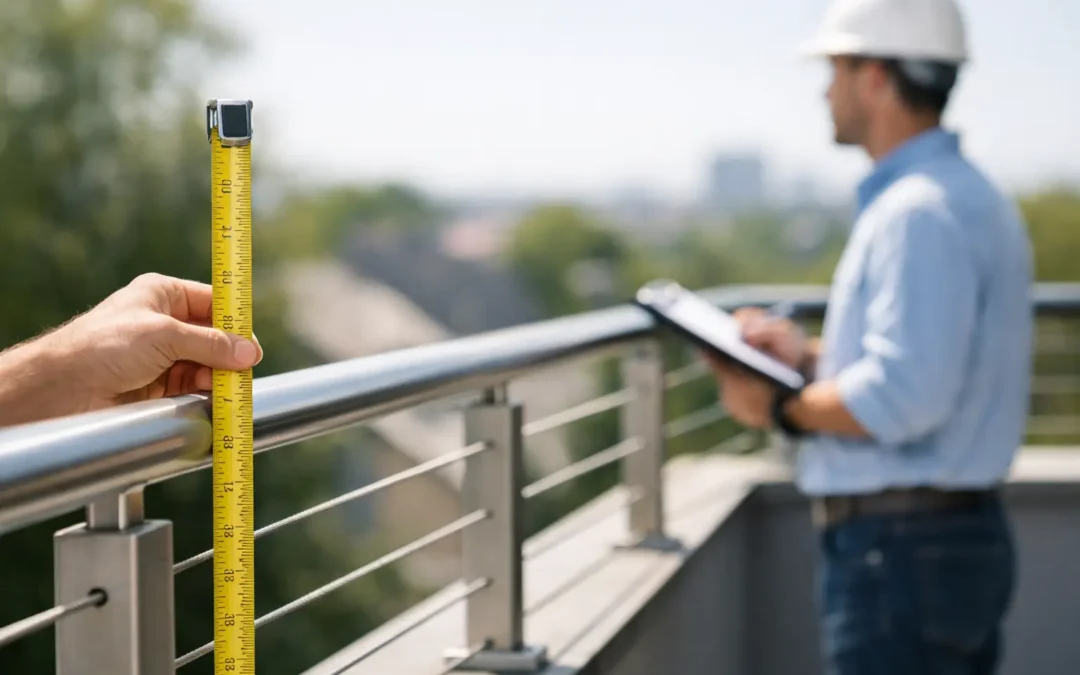
A railing can look perfectly balanced, feel solid in the hand, and still fail inspection if the height is off by even a small margin. That is usually where people start asking, what is railing height code, and the honest answer is that there is a standard baseline, but the exact requirement depends on where the railing is installed, what kind of railing it is, and which local code your project falls under.
For homeowners and property managers, that distinction matters. A stair handrail is not measured the same way as a deck guard. A second-floor balcony is treated differently from an interior stair. And if you are planning a custom glass or metal system, the design has to do more than match the architecture. It has to meet the code requirements that make the installation safe, approvable, and durable in real-world use.
What is railing height code for most projects?
In plain terms, railing height code refers to the minimum required height for a guardrail or handrail based on the location and the risk of falling. In many residential projects in the US, guards are commonly required to be at least 36 inches high, while handrails on stairs are often set between 34 and 38 inches. In many commercial settings, guard height is often 42 inches.
That sounds simple until you get into the details. Code usually separates railings into two categories: guards and handrails. A guard is the protective barrier that prevents someone from falling off an elevated surface such as a deck, balcony, landing, or open-sided stair. A handrail is the graspable rail designed to support someone using the stairs. One system can sometimes do both jobs, but the measuring points and requirements are not always the same.
This is where many projects go sideways. Someone assumes one number applies everywhere, fabrication starts, and then the inspector measures from a different point than expected. Fixing that after the fact is far more expensive than building it correctly from the beginning.
Guards vs. handrails: the height is not the same
If your project includes open sides, exterior landings, or elevated platforms, you are usually dealing with guard requirements. If your project includes a stair run where people need support while going up or down, you are dealing with handrail requirements. The difference matters because code treats them differently.
Guardrail height
For many one- and two-family residential applications, guards are generally required when the walking surface is more than 30 inches above the floor or grade below. In those cases, a typical minimum guard height is 36 inches. On some decks, balconies, and porches, that 36-inch dimension is measured from the finished walking surface to the top of the guard.
In commercial properties, multifamily settings, and some buildings governed by different codes, the required guard height is often 42 inches. That extra height is there for a reason. The occupancy type, expected traffic, and overall risk profile are different.
Handrail height
Handrails are usually measured vertically from the nosing of the stair treads to the top of the gripping surface. In many US codes, the acceptable range is 34 to 38 inches. That range gives some flexibility, but not much. If the rail is too low, it may not provide proper support. If it is too high, it can become awkward or unsafe to grip.
A custom stair system often needs careful coordination here, especially if you want a clean modern look. Minimalist design still has to respect the geometry of the stair and the code measurement points.
Where railing height code changes by application
When people search what is railing height code, they are usually looking for one universal number. The reality is that the answer changes with the application.
Decks and porches
On residential decks and porches, a guard is generally required once the drop exceeds the code threshold, often 30 inches. In many cases, the minimum height is 36 inches. Some local jurisdictions may enforce more specific requirements based on deck configuration, attachment, or occupancy.
Balconies and elevated landings
Balconies often receive closer scrutiny because the fall risk is higher and the exposure is more obvious. Residential balcony guards may still fall under the 36-inch rule, but commercial or multifamily projects commonly require 42 inches. If the project includes glass infill, there may also be additional engineering requirements for panel thickness, attachment, and load resistance.
Interior stairs
Interior stairs typically require handrails within the 34- to 38-inch range. Open-sided stairs may also require guards, which means one assembly may need to satisfy two sets of expectations at the same time. That can affect profile selection, post spacing, and top rail design.
Exterior stairs
Exterior stair railings need to meet the same basic height logic, but weather exposure adds another layer. Water, ice, and temperature swings can affect how rail systems perform over time. Material choice and installation quality matter just as much as hitting the correct measurement on day one.
The measurement points matter more than most people expect
One of the biggest sources of confusion is not the required height itself. It is how that height is measured.
A stair handrail is commonly measured from the front edge, or nosing, of each tread to the top of the gripping surface. A deck or balcony guard is measured from the finished walking surface to the top of the guard. If tile, pavers, wood decking, or a membrane system changes the final floor height, that can change the code measurement too.
That is why experienced fabrication and installation teams take site measurement seriously. A railing that looked correct on a rough framing stage can end up wrong after finish materials are installed. Precision is not just about fit and finish. It is about compliance.
Height is only part of code compliance
A railing can meet the required height and still fail for other reasons. That is especially common with custom systems where the visual goal is a slim, open look.
Spacing rules are a major example. Many guards must be designed so a 4-inch sphere cannot pass through openings in most areas. Stair guards may have some variation depending on the location. Handrails also have graspability requirements, clearance requirements from adjacent walls, and continuity expectations along the stair run.
Load resistance is another key factor. Railings are not judged only on appearance. They are expected to withstand specific loads and forces. For glass systems, that can involve tempered or laminated glass, engineered hardware, and stamped drawings depending on the project. For metal systems, weld quality, anchorage, substrate condition, and finish durability all matter.
In other words, code is not just a number at the top of the rail. It is the whole assembly.
Why local code and permitting still matter
Even if you know the common national standards, local enforcement can still vary. Jurisdictions may adopt different code editions, amend them, or apply them differently depending on the property type. Renovation work can also create gray areas when an older structure is being updated in phases.
That is why the best approach is not to guess. It is to work from field measurements, project-specific drawings, and a clear understanding of the governing code for that site. On more complex jobs, engineering review is not just helpful. It is the difference between a smooth approval process and a costly redesign.
For custom metal and glass work, that process protects both design intent and budget. A properly reviewed railing system is easier to fabricate accurately, easier to install on schedule, and far less likely to cause inspection issues.
What homeowners should ask before ordering a railing
Before approving any railing design, ask whether the system is being built as a guard, a handrail, or both. Ask what code applies to the property, how the height will be measured, and whether finish materials could affect the final dimension. If the project includes glass, ask whether the panels and hardware have been engineered for the application.
You should also ask who is responsible for site measurement, drawings, approval coordination, and installation. Those details are where expensive mistakes usually happen. A good railing partner does not just offer attractive options. They build a process that reduces uncertainty from the first visit through final installation.
At Iron & Glass Designs, that project discipline is part of the value. Custom railings should feel tailored, not improvised.
The right code-compliant railing should still look exceptional
There is a persistent myth that code-compliant railings have to look bulky or generic. They do not. When a system is designed properly, the correct height can feel intentional, elegant, and proportional to the space. Glass can preserve views. Aluminum and stainless steel can deliver clean lines. Wrought iron can add character without sacrificing safety.
The best result is not choosing between design and compliance. It is getting both from the same process.
If you are planning a stair, deck, balcony, or interior renovation, treat railing height as an early design decision, not a last-minute check. It is one of the simplest ways to protect the look of the project, the safety of the people using it, and the approval path that keeps everything moving forward.