
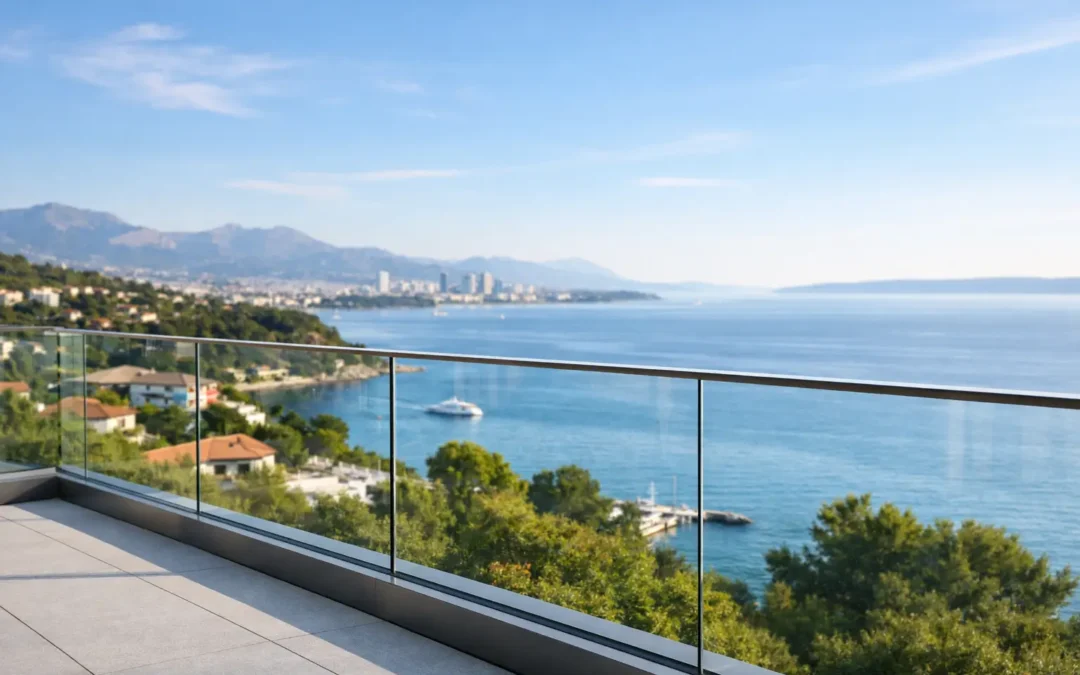
A balcony should give you something back every time you step outside. If the railing cuts your sightline at seated height, breaks up the horizon with heavy pickets, or makes a small outdoor area feel boxed in, the space never reaches its full potential. That is exactly how glass balcony railings improve views – they reduce visual barriers, let light travel freely, and make the edge of a balcony feel open instead of closed.
For homeowners and property investors, that difference is not just aesthetic. It changes how a space feels, how often it gets used, and how polished the property looks from both inside and outside. When the goal is a cleaner architectural finish without giving up safety, glass is often the strongest solution.
Why glass changes the experience of a balcony
Traditional railings do their job structurally, but visually they can interrupt the reason a balcony exists in the first place. Vertical balusters, horizontal members, and thicker framing create repeated visual stops. Even well-made metal railings can block part of a skyline, garden, waterfront, or backyard.
Glass works differently. Instead of asking your eye to look through a pattern, it allows a more continuous view. You still have a defined, code-compliant barrier, but the barrier does not dominate the experience. That matters whether your home overlooks a ravine, a city street, a pool area, or simply a well-designed backyard you want to enjoy from above.
This is one of the clearest answers to how glass balcony railings improve views. They do not create a better landscape – they stop the railing from competing with it.
How glass balcony railings improve views from inside the home
The benefit starts before you even open the door. From a kitchen, bedroom, or living room, the balcony railing is often part of the daily sightline. If that railing is visually heavy, it becomes a permanent interruption across windows and doors.
With glass, the transition between indoors and outdoors feels more natural. Natural light moves deeper into the room, and the view beyond the balcony remains visible whether you are standing or sitting. This can make interior spaces feel larger and calmer, especially in homes where the balcony is directly off a main living area.
That effect is especially valuable in modern renovations. Clients often invest in larger windows, open layouts, and cleaner finishes because they want more visual continuity. Installing a solid or highly segmented railing at the edge of that design works against the rest of the upgrade. Glass keeps the overall look aligned.
A clearer view also makes smaller balconies feel bigger
Not every property has a wide terrace or oversized outdoor platform. Many balconies in urban and suburban homes are compact, which means every design choice affects how spacious they feel.
Glass helps because it preserves depth. When your eye can continue past the edge instead of stopping at a dense railing, the balcony feels less confined. The footprint has not changed, but the perception of space has.
This is one reason glass is popular in townhomes, condo terraces, rear balconies, and narrow second-floor outdoor spaces. If square footage is limited, visual openness becomes even more important. A lighter edge can make the difference between a balcony that feels practical and one that feels inviting.
The aesthetic advantage is real, but it is not one-size-fits-all
Glass is often chosen for its modern appearance, and that reputation is well earned. It delivers crisp lines, a lighter profile, and a more refined finish than many conventional railing styles. On contemporary homes, it often looks like the obvious choice.
But the appeal is broader than modern design alone. Glass can also work well on transitional homes, custom renovations, and mixed-material exteriors where metal, stone, and wood are already part of the palette. The key is the detailing – frame style, hardware finish, post layout, and the way the system ties into the architecture.
That is where custom fabrication matters. A glass railing should not look like an add-on. It should feel designed for the structure it is attached to. Done well, it supports the architecture without pulling attention away from the home or the view.
Sightlines depend on the system you choose
Not all glass balcony railings deliver the same result. Some systems maximize openness more than others, and the right choice depends on your project, budget, structural conditions, and local code requirements.
Framed glass systems can still provide a clean, open look, especially when posts and top rails are carefully designed. They usually offer a balanced combination of visibility, durability, and cost control. For many residential projects, this is the practical sweet spot.
More minimal systems reduce visible hardware even further, which can create a stronger uninterrupted-glass effect. These often appeal to clients chasing the most contemporary finish possible. The trade-off is that the engineering, installation method, and budget may become more demanding.
There is no universal best option. A higher-end minimalist system may look exceptional on one property, while a framed custom solution may be the smarter and more durable choice on another. The goal is not to force the same detail onto every balcony. The goal is to match the railing to the property and the performance requirements.
Light, reflections, and everyday livability
Another reason how glass balcony railings improve views is such a common question is that the benefit goes beyond the direct line of sight. Glass also changes how light behaves around the balcony.
Because it allows more daylight through, the outdoor area tends to feel brighter and less enclosed. Interior rooms can benefit as well, particularly if the balcony sits outside a major window wall. A darker, more segmented railing can cast stronger visual shadows and create a heavier threshold between inside and outside. Glass softens that boundary.
Of course, transparency comes with some practical considerations. Glass shows dirt, water spots, pollen, and fingerprints more readily than many metal systems. If your balcony is exposed to heavy weather, nearby trees, or frequent use, routine cleaning matters. For most owners, that maintenance is straightforward and well worth the result, but it should be part of the decision.
Reflections are another variable. Depending on sun angle, surrounding buildings, and the type of glass used, there may be moments when glare changes how the panels read visually. In most cases, this does not outweigh the openness of the system, but it is worth discussing during design.
Safety and openness can work together
A common hesitation is whether a clearer railing somehow feels less secure. In practice, a properly designed and professionally installed glass system is built to provide safety first. The difference is that it does not need to look bulky to perform that role.
For residential and commercial projects alike, the details matter – correct measurements, engineered drawings where required, proper anchoring, code alignment, and precise installation. This is not a product category where guesswork should enter the process. If the view is the visible reward, the invisible value is the structure behind it.
That is why many clients prefer a full-service partner who can handle site measurements, drawings, approvals, production, and installation under one coordinated process. A railing should look clean on day one, but it also needs to remain dependable over time.
Where glass balcony railings make the biggest impact
The strongest results usually show up in spaces with something worth framing rather than blocking. Waterfront homes are the obvious example, but they are far from the only one. Backyard landscaping, pool areas, wooded lots, city skylines, and elevated decks all benefit from more open sightlines.
Even on properties without a dramatic view, glass can still improve the experience. It lets you see more sky, more light, and more of the space around the home. That alone can make a balcony feel more premium.
At Iron & Glass Designs, we often see clients respond not just to the finished look, but to the feeling of the space after installation. The balcony feels less like a boundary and more like an extension of the architecture.
When glass may not be the perfect fit
Glass is a strong option, but it is not the answer for every project. Some homeowners prefer the privacy of more opaque materials, especially if neighboring properties are close. Others want a more traditional design language that ornamental metal expresses better.
Budget can also influence the decision. While glass delivers a high-end appearance, the final cost depends on panel sizing, hardware, structural conditions, and installation complexity. On some projects, a different railing material may offer a better balance of look and budget.
That is why the best recommendations are always project-specific. A good railing decision is not about chasing a trend. It is about understanding how the space is used, what the home needs architecturally, and what level of finish the owner wants to achieve.
When a balcony is meant to showcase a setting rather than hide it, glass usually earns serious consideration. It gives you the safety a railing is supposed to provide while letting the space breathe, the light move, and the view do what it was always meant to do.