
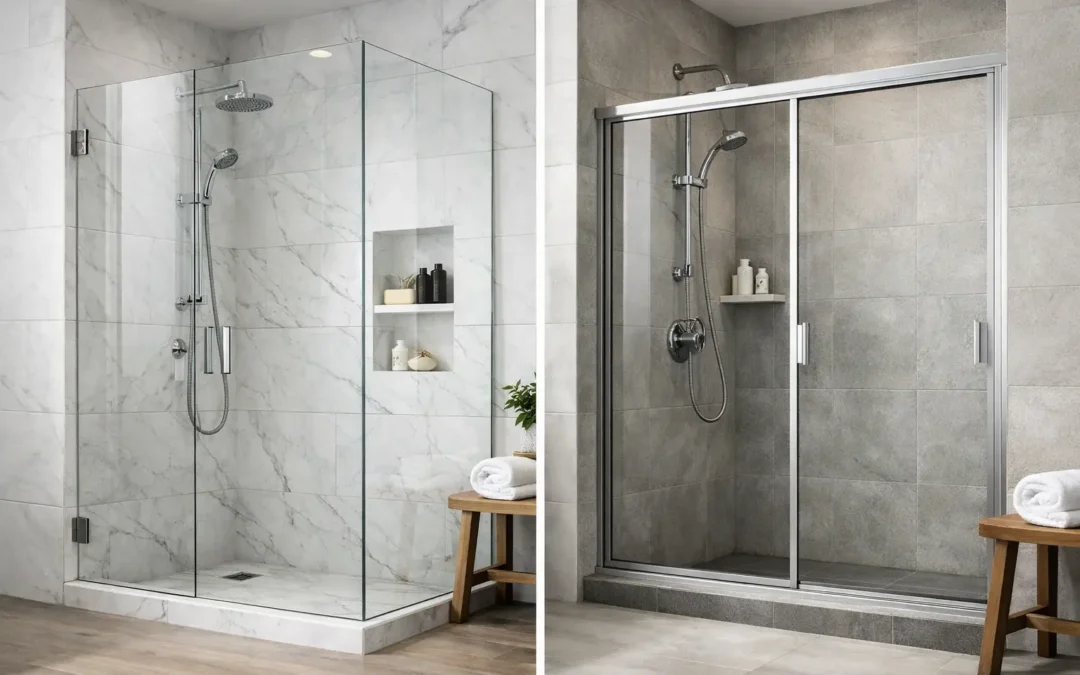
A shower enclosure can change the entire feel of a bathroom faster than almost any other finish. When homeowners compare a frameless vs framed shower enclosure, they are usually weighing more than looks. They are deciding how open the room feels, how much maintenance they want, what level of durability fits the household, and where they want to invest their budget.
This is one of those choices where the right answer depends on the space, the users, and the standard you want the finished bathroom to meet. A great enclosure should look sharp on day one, perform well for years, and feel like it belongs with the rest of the home.
Frameless vs framed shower enclosure: what actually changes?
The biggest difference is structural. A framed shower enclosure uses metal around the glass panels and door to provide support. A frameless enclosure relies on thicker tempered glass with minimal hardware, so the glass itself does more of the visual work and much of the structural work.
That difference affects nearly everything else. It changes how clean the sightlines look, how much metal you see, how the door operates, how easy the enclosure is to clean, and how custom the final result feels. In a bathroom where every inch matters, those details are not small.
Framed enclosures tend to feel more traditional and more defined. Frameless enclosures feel lighter, more open, and more architectural. If your goal is a modern bathroom with uninterrupted tile lines, frameless usually has the edge. If your priority is a practical enclosure at a lower cost, framed often makes more sense.
Style and visual impact
For many homeowners, this is where the decision starts. A frameless shower enclosure creates a cleaner view across the room. Because there is very little visible metal, your tile, stone, fixtures, and lighting become the focus. That can make a smaller bathroom feel larger and a well-designed bathroom feel more finished.
Framed enclosures introduce more visual lines. That is not always a drawback. In some bathrooms, especially those with more conventional finishes, a framed enclosure can look balanced and appropriate. If you already have strong metal details in the room, the frame may even help tie the design together.
Still, when clients want an upscale, custom look, frameless usually wins. It delivers the kind of simplicity that is hard to fake. The enclosure feels integrated into the room rather than added onto it.
Cost: upfront price vs long-term value
A framed shower enclosure is usually the more budget-friendly option upfront. The thinner glass costs less, and the framing system helps simplify the build. If you are updating a rental property, refreshing a secondary bathroom, or trying to control renovation costs, framed can be a smart choice.
Frameless enclosures usually cost more because they use thicker glass, premium hardware, and more precise fabrication and installation. There is less room to hide uneven walls or measurement errors, so the process has to be exact.
That higher price does not mean frameless is automatically the better investment for everyone. It depends on the property and your goals. In a primary bathroom or a higher-end renovation, many homeowners feel the visual upgrade and custom finish justify the added cost. In a lower-traffic guest bath, framed may deliver the value you need without overspending.
Durability and daily use
Both options can perform well when they are properly designed and installed. The better question is how they wear over time in real households.
Framed enclosures benefit from the extra support of the metal frame. That can make them feel solid and dependable, especially in standard configurations. They are often a practical fit for busy family bathrooms where function comes first.
Frameless enclosures use thicker tempered glass and heavy-duty hinges or clamps. When they are fabricated correctly and installed with precision, they are extremely strong. But the quality of the measurements, hardware, and installation matters more. A frameless system should never feel like a shortcut product. It needs to be treated as a custom glass installation.
This is where a disciplined process matters. Site measurement, job-specific drawings, client approval, and professional installation all help ensure the enclosure looks right and performs right.
Cleaning and maintenance
This is one of the most practical parts of the frameless vs framed shower enclosure decision.
Framed enclosures have more edges, joints, and channels where soap residue, moisture, and mineral buildup can collect. That does not make them difficult to own, but it usually means a little more cleaning effort over time. The bottom track in particular can become a trouble spot if it is not maintained regularly.
Frameless enclosures are generally easier to keep looking clean because there are fewer metal channels and fewer places for grime to hide. The glass still needs routine care, especially in areas with hard water, but the overall enclosure is simpler to wipe down.
For homeowners who want low visual clutter and lower maintenance, frameless often feels better in everyday use. It is not maintenance-free, but it is usually easier to keep crisp.
Water control and performance
Framed enclosures usually offer a tighter seal because the frame and tracks help contain water. That can be useful in bathrooms where splash control is a major concern, especially with certain showerhead placements or high-use family bathrooms.
Frameless enclosures can also perform very well, but they need careful planning. Door gaps, panel placement, slope, and hardware layout all matter. A well-designed frameless enclosure should balance clean aesthetics with practical water management.
This is where custom work makes a difference. Every bathroom has its own conditions – tile layout, wall alignment, curb design, and shower dimensions all affect performance. A good enclosure is not just chosen from a category. It is tailored to the room.
Installation complexity
A framed unit can be more forgiving because the frame helps accommodate minor inconsistencies in the opening. That makes installation a bit more straightforward in some situations.
Frameless glass demands tighter tolerances. Walls that are out of plumb, uneven tile, or poorly planned layouts show up quickly. That is why professional measurement and fabrication are so important. The cleaner the design, the less room there is to hide mistakes.
For homeowners, that should not be a reason to avoid frameless. It should be a reason to work with a company that approaches the project with care from the beginning. At Iron & Glass Designs, that means a controlled process from site visit to drawings to installation, so the finished enclosure is not only attractive but dependable.
Which option is better for your bathroom?
If you want the most modern look, want to highlight quality tile work, and care about a custom finish, a frameless enclosure is usually the stronger choice. It works especially well in primary bathrooms, renovated ensuite spaces, and homes where clean architectural lines matter.
If budget is tighter, the bathroom is more utilitarian, or you want a straightforward enclosure with strong water containment, framed may be the better fit. It can still look polished when the proportions, finish, and installation are right.
There are also cases where the answer sits somewhere in the middle. Semi-frameless designs can offer some of the openness of frameless glass with a bit more structure and cost control. For some projects, that balance is exactly right.
What to ask before you decide
Before choosing between framed and frameless, look at the bathroom as a whole. Think about who uses it every day, how long you plan to stay in the home, and whether this is a simple update or a design-driven renovation. Consider the tile investment, the room size, the style of the fixtures, and how much maintenance you are comfortable with.
Most important, think beyond the product label. The quality of the glass, the precision of the measurements, the hardware selection, and the installation standard all affect the final result. A well-executed enclosure feels effortless. A poorly executed one never does.
The best shower enclosure is the one that fits your bathroom, your expectations, and your budget without compromise in the areas that matter most to you. If you are building for a cleaner look and a stronger finished impression, frameless is often worth the step up. If you need practical performance and controlled cost, framed remains a solid option.
The smartest next move is not guessing from photos. It is getting the space measured, the options reviewed, and the details worked out before glass is ever ordered.