
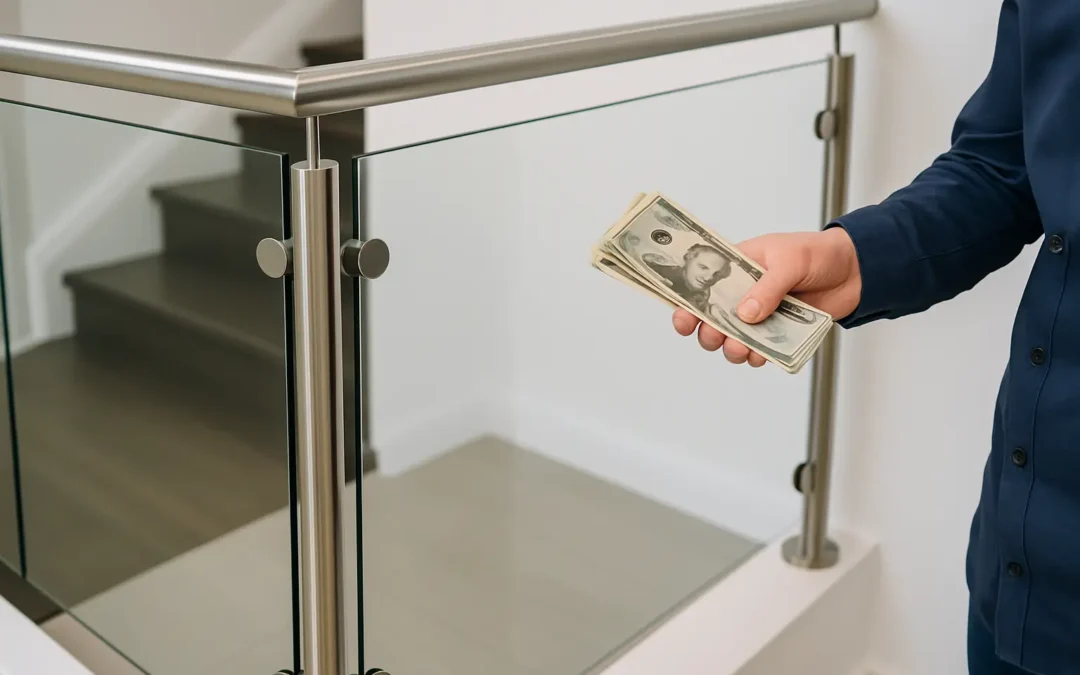
You can spot a well-built glass railing from across the room. The lines are clean, the panels sit perfectly plumb, and nothing rattles when you put your hand on the cap rail. That level of finish is exactly why pricing varies so much from one “glass railing” quote to the next.
If you’re budgeting a renovation or a new build, a custom glass railing cost breakdown is the fastest way to get clarity. Not a generic price range pulled from a catalog – a real look at what you’re paying for, why it matters, and where you can dial the budget up or down without sacrificing safety or code compliance.
Custom glass railing cost breakdown by category
Most custom glass railing projects price out as a package, but the costs still fall into consistent buckets: design and measurements, materials (glass plus hardware and metalwork), engineering, and installation. The details inside each bucket are where the numbers move.
1) Site measuring, design, and job-specific drawings
Custom starts before fabrication. Accurate field measurements are the difference between panels that drop in cleanly and panels that need costly rework.
On straightforward runs, the “design” piece may look simple. But even then, you’re paying for layout decisions that affect performance and appearance: where seams land, how corners resolve, how the railing ties into walls or posts, and how transitions work from stairs to landings. On more complex jobs – spiral stairs, multiple elevations, curved conditions, or tricky concrete edges – time in drawings increases because tolerances get tighter.
Expect this phase to include a site visit, measurements, and drawings for approval. That structure keeps the project controlled: you see exactly what you’re getting before anything is built.
2) Glass: thickness, type, edges, and panel sizing
Glass is often the single biggest material line item. Two railings can look similar in photos yet use very different glass.
Thickness matters because it relates to stiffness, deflection, and what hardware system can support it. Tempered glass is common, but laminated glass adds a safety layer that can be required or preferred depending on the application. Laminated panels tend to cost more because you’re paying for that interlayer and the manufacturing process.
Edge finishing also affects price. Clean, polished edges and consistent corner detailing take time and precision at the glass shop. Then there’s panel sizing: larger panels reduce the number of vertical seams for a more “all-glass” look, but large panels can be more expensive to produce and more demanding to handle on site.
If your priority is a minimalist aesthetic with fewer breaks, plan for the glass line item to rise. If you’re open to smaller panels, you may lower costs while still keeping the space bright and modern.
3) Hardware and mounting system: where the budget really shifts
The mounting system is the hidden engine of the railing. It also drives a lot of the price difference between quotes.
Frameless base shoe systems (a continuous channel that anchors into the structure) typically sit at a higher price point. They require precision layout, proper anchoring, and careful glass setting to achieve that floating look.
Standoff systems (glass panels held off the side of a stair or balcony edge with metal standoffs) can be a clean, modern choice, but they depend heavily on the structure behind the mounting points. If reinforcement is required, that can add cost even if the hardware itself is straightforward.
Post-and-glass systems (metal posts with glass infill) can be more budget-friendly in some situations because posts simplify structural load paths and can reduce the demand on a slab edge or fascia. They do introduce more vertical lines, so the trade-off is aesthetic: more framing, less “invisible” glass.
Hardware finish matters too. Brushed stainless, powder-coated aluminum, and custom metalwork all price differently, and coastal or high-exposure environments can call for higher-grade materials.
4) Top rails and handrails: optional, but not always
Some clients want the pure glass look with no top rail. Others prefer a slim metal cap or a graspable handrail for comfort and code.
Adding a top rail increases material and labor, but it can also improve feel and long-term durability because it protects the top edge and can help unify slight panel variations. On stairs, a graspable handrail is often required. If you need both a glass guard and a separate handrail, that’s another scope item with its own mounting details.
The cost here depends on length, profile choice, finish, and how many returns, corners, or wall transitions are involved.
5) Engineering review and stamped drawings
If you’re comparing quotes and one includes engineering while another doesn’t, you’re not comparing the same thing.
Many glass railing installations – especially on balconies, stairs, and commercial projects – benefit from engineer review and stamped drawings for permitting and peace of mind. Engineering looks at loads, anchoring, and how the railing interacts with the existing structure. That’s particularly important when you’re mounting to concrete edges, wood framing, or retrofitting an older home where conditions aren’t perfectly square.
Engineering is a cost, but it’s also risk control. When it’s done early and tied to job-specific drawings, it reduces surprises during inspection and helps keep the project on schedule.
6) Installation labor, equipment, and site conditions
Labor is not just “hours on site.” It’s the crew’s experience, the tools required, and the plan to install safely and accurately.
A ground-floor interior guard is generally easier than a third-floor exterior balcony with limited access. Stairs add complexity because every panel angle and height change needs to land cleanly. Tight urban sites can require careful scheduling for deliveries, glass handling, and protection of finished surfaces.
If the job calls for specialized lifting equipment, extra manpower for large panels, or complex anchoring layouts, installation cost will reflect that. A professional installer also builds in time for alignment and finishing – that’s where the premium look comes from.
7) Permits, demolition, and prep work (often missed in early budgets)
The railing might be the visible upgrade, but prep work can be the budget surprise.
If you’re removing an old guard, repairing substrates, leveling a slab edge, or reframing where posts used to be, those steps can add meaningful cost. Waterproofing and exterior flashing details also matter. Skipping them can create long-term problems that cost more than the railing ever did.
Permits vary by jurisdiction and scope. If your project requires permit drawings, engineering, or inspections, plan for that timeline and expense upfront.
What makes custom pricing worth it (and when it may not)
Custom glass railings earn their keep when you care about fit, finish, and compliance. If your space has non-standard dimensions, unique design goals, or you want a system that looks intentional instead of “adapted,” custom fabrication is the right route.
There are situations where a simpler system may be enough: a short run in a low-visibility area, a temporary property upgrade, or a project where speed matters more than design. The trade-off is usually in detailing. Off-the-shelf solutions can limit panel sizing, hardware choices, and how cleanly you can resolve corners and transitions.
The bigger the visual impact of the railing – front entry stairs, open-concept interiors, rooftop terraces – the more clients tend to appreciate the difference that custom work delivers.
How to budget smarter without cutting corners
If you want the modern look but need to manage costs, the goal is to make smart scope decisions, not safety compromises.
First, decide where you want “frameless.” Many homes look incredible with a frameless section in the hero area (like a main staircase) and a simpler post-and-glass approach in secondary zones. Done well, it still reads cohesive.
Second, be realistic about handrail requirements. If code calls for a graspable handrail, it’s better to integrate it into the design early than to add it later as an afterthought.
Third, simplify geometry when you can. Clean straight runs and consistent panel modules typically cost less than multiple jogs, tight landings, or unusual angles.
Finally, choose finishes with the long view in mind. A finish that holds up to weather and fingerprints keeps the railing looking premium year after year, which protects the investment.
What to ask for when comparing quotes
A glass railing quote should be easy to understand and specific enough that you know what is included. If it’s vague, you’ll feel it later in change orders.
Ask whether the quote includes a site measure, approval drawings, engineering review (and stamps if required), the exact glass type and thickness, the full hardware system, and installation. Clarify whether permits, demolition, substrate repairs, and disposal are included or excluded.
You should also ask how the installer handles field tolerances. Real buildings are rarely perfectly square. A professional process accounts for that with careful measuring, clear drawings, and a controlled install plan.
If you’re in the Toronto and Mississauga area and want a team that handles the full workflow – measurement, drawings, engineer review, fabrication, and on-time installation – you can request a free quote through Iron & Glass Designs.
A realistic way to think about the final number
The most accurate “cost breakdown” is the one built around your site conditions and goals. Glass railings aren’t priced like a commodity because they’re not installed like one. The same linear footage can change dramatically based on mounting method, glass specification, structural readiness, and how clean you want the final sightlines.
If you focus on one decision at a time – the look you want, the code requirements, the mounting system that fits your structure, and the level of finish that matches your home – the budget starts to feel less like a guess and more like a plan you can stand behind when the last panel is set and the space finally opens up.